

Smart Homes Market In 2029
Smart Homes Market Growth
Smart Homes Market Trends
Smart Homes Market Forecast
The Business Research Company’s Smart Homes Global Market Report 2025 - Market Size, Trends, And Global Forecast 2025-2034
LONDON, GREATER LONDON, UNITED KINGDOM, December 19, 2025 /EINPresswire.com/ -- Smart Homes Market to Surpass $328 billion in 2029. In comparison, the Buildings Construction market, which is considered as its parent market, is expected to be approximately $9,379 billion by 2029, with Smart Homes to represent around 3% of the parent market. Within the broader Construction industry, which is expected to be $20,447 billion by 2029, the Smart Homes market is estimated to account for nearly 2% of the total market value.
Which Will Be the Biggest Region in the Smart Homes Market in 2029
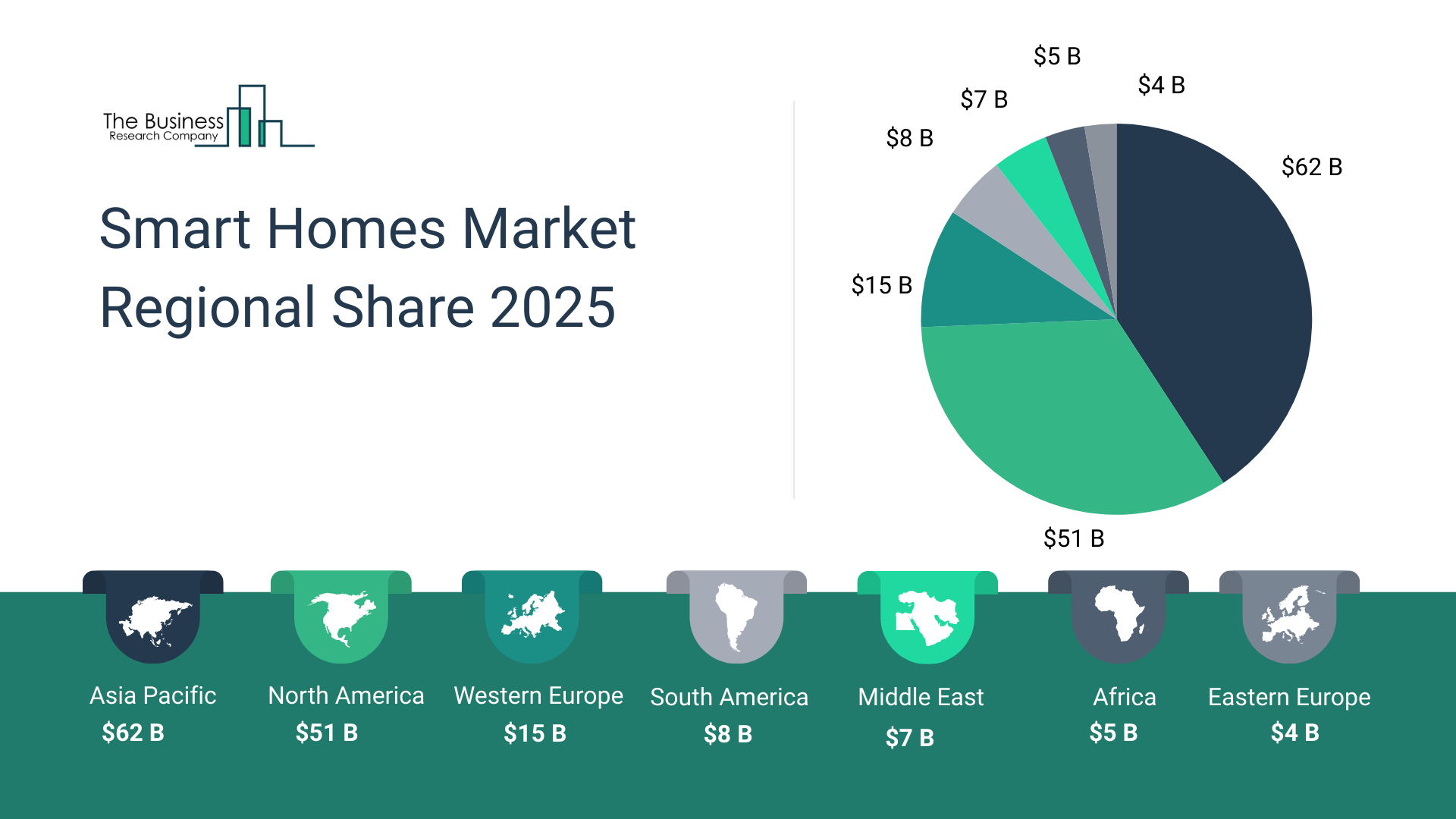
Asia Pacific will be the largest region in the smart homes market in 2029, valued at $138,121 million. The market is expected to grow from $51,985 million in 2024 at a compound annual growth rate (CAGR) of 22%. The exponential growth can be attributed to an increase in work-from-home trends, and proliferation of affordable smart devices.
Which Will Be The Largest Country In The Global Smart Homes Market In 2029?
The USA will be the largest country in the Smart Homes market in 2029, valued at $99,497 million. The market is expected to grow from $38,853 million in 2024 at a compound annual growth rate (CAGR) of 21%. The exponential growth can be attributed to the rising need for smart security and surveillance systems and strategic partnerships and collaborations.
Request a free sample of the Smart Homes Market report:
https://www.thebusinessresearchcompany.com/sample_request?id=6603&type=smp
What will be Largest Segment in the Smart Homes Market in 2029?
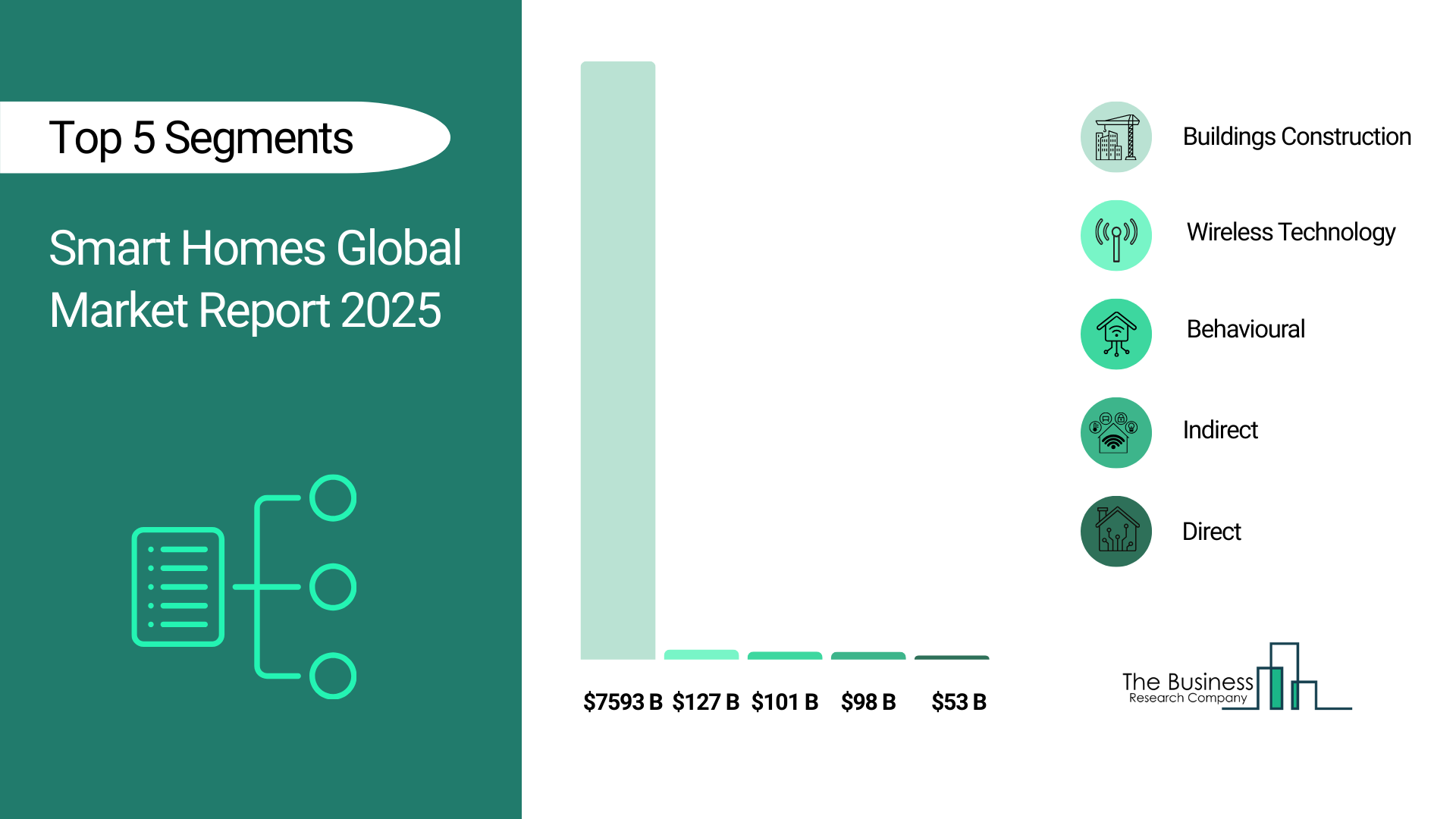
The smart homes market is segmented by product into lighting control, security and access control, heating, ventilation and air conditioning (HVAC) control, entertainment control and other controls, smart kitchen, home appliances and other products. The security and access control market will be the largest segment of the smart homes market segmented by product, accounting for 34% or $113,260 million of the total in 2029. The security and access control market will be supported by rising concerns about home security and burglary prevention, increasing adoption of smart locks and video doorbells, advancements in AI-driven surveillance cameras for real-time monitoring and increasing awareness of cybersecurity threats driving the need for secure systems.
The smart homes market is segmented by software and services into behavioural and proactive. The behavioural market will be the largest segment of the smart homes market segmented by software, accounting for 63% or $205,422 million of the total in 2029. The behavioural market will be supported by the growing adoption of data-driven insights for energy optimization, increasing consumer interest in understanding household consumption patterns, advancements in AI and machine learning for personalized recommendations, integration of behavioural analytics in smart home apps for enhanced user engagement and eco-friendly living and government initiatives promoting smart energy usage through behavioural insights.
The smart homes market is segmented by sales channel into direct and indirect. The indirect market will be the largest segment of the smart homes market segmented by sales channel, accounting for 69% or $225,637 million of the total in 2029. The indirect market will be supported by the widespread availability of smart home products through third-party retailers and e-commerce platforms, increasing collaboration between manufacturers and distributors for broader market reach and the convenience of multi-brand retailing enabling diverse product choices.
The smart homes market is segmented by technology into wireless technology and cellular network technology. The wireless technology market will be the largest segment of the smart homes market segmented by technology, accounting for 81% or $267,372 of the total in 2029. The wireless technology market will be supported by increasing demand for seamless and flexible home automation solutions, growing adoption of Wi-Fi, Zigbee and Z-Wave-enabled smart devices, advancements in low-power wireless communication for energy-efficient operation, rising consumer preference for easy installation and scalability, expanding integration of AI and IoT for enhanced automation, increasing security enhancements in wireless protocols to prevent cyber threats and the proliferation of smart home ecosystems enabling interoperability across multiple devices.
What is the expected CAGR for the Smart Homes Market leading up to 2029?
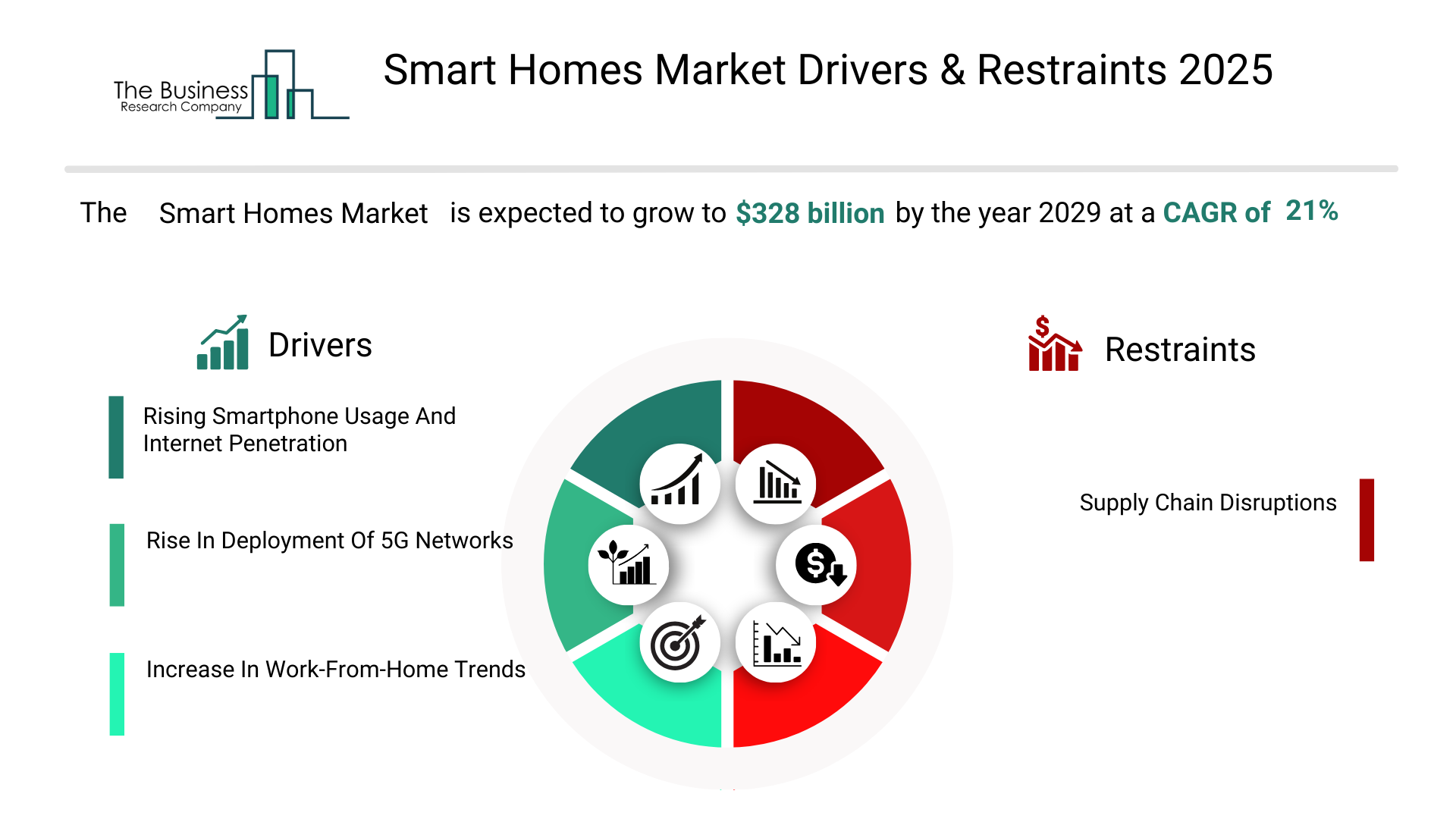
The expected CAGR for the smart homes market leading up to 2029 is 21%.
What Will Be The Growth Driving Factors In The Global Smart Homes Market In The Forecast Period?
The rapid growth of the global smart homes market leading up to 2029 will be driven by the following key factors that are expected to reshape residential living, energy management, home security, and the built environment worldwide.
Rising Smartphone Usage And Internet Penetration - The rising smartphone usage and internet penetration will become a key driver of growth in the smart homes market by 2029. As smartphones become essential hubs for managing connected devices ranging from lighting and security to HVAC and entertainment businesses are investing in IoT-enabled solutions that enhance convenience and efficiency. The widespread availability of high-speed internet and the proliferation of mobile applications enable real-time monitoring, automation, and remote control, driving consumer interest in smart living. As a result, the rising smartphone usage and internet penetration growth is anticipated to contributing to a 1.9% annual growth in the market.
Rise In Deployment Of 5G Networks - The rise in deployment of 5g networks will emerge as a major factor driving the expansion of the market by 2029. As 5G infrastructure expands globally, consumers benefit from enhanced performance of connected devices, supporting real-time automation, high-definition streaming, and seamless interaction between multiple IoT-enabled systems. The improved network capabilities of 5G allow for the integration of advanced smart home solutions such as AI-driven security systems, smart appliances, and immersive entertainment platforms. Consequently, the rise in deployment of 5G networks demand growth is projected to contributing to a 1.4% annual growth in the market.
Increase In Work-From-Home Trends - The increase in work-from-home trends will serve as a key growth catalyst for the market by 2029. As remote and hybrid work models become more widespread, consumers are investing in smart solutions such as advanced lighting systems, smart thermostats, and noise-canceling devices to create efficient and adaptable workspaces. The integration of connected devices enhances the work-from-home experience by enabling automation, energy management, and remote access to home functions. Businesses are responding by offering smart home products tailored to remote workers, including collaboration tools, smart security systems, and IoT-enabled appliances. Therefore, this increase in work-from-home trends growth is projected to supporting to a 0.9% annual growth in the market.
Expansion Of E-Commerce – The expansion of e-commerce will become a significant driver contributing to the growth of the market by 2029. The surge in online shopping is driving demand for smart doorbells, locks, and surveillance systems that enable contactless delivery and real-time monitoring of parcels. Additionally, smart home hubs and voice assistants are increasingly used to streamline online transactions, track orders, and manage household inventories. Consequently, the expansion of e-commerce growth is projected to contributing to a 0.4% annual growth in the market.
Access the detailed Smart Homes report here:
https://www.thebusinessresearchcompany.com/report/smart-homes-global-market-report
What Are The Key Growth Opportunities In The Smart Homes Market in 2029?
The most significant growth opportunities are anticipated in the safety and access control smart home market, the behaviour-driven smart home market, the smart home ecosystem market, and the wireless-enabled smart home market. Collectively, these segments are projected to contribute over $502 billion in market value by 2029, driven by advancements in IoT integration, increasing consumer demand for enhanced convenience and security, and the proliferation of wireless technologies enabling seamless connectivity. This growth underscores the rapid expansion of intelligent home solutions that offer personalized automation and robust security features, fuelling transformative developments within the broader smart home industry.
The wireless-enabled smart home market is projected to grow by $160,753 million, the smart home ecosystem market by $144,625 million, the behaviour-driven smart home market by $119,472 million, the safety and access control smart home market by $77,527 million, over the next five years from 2024 to 2029.
Learn More About The Business Research Company
The Business Research Company (www.thebusinessresearchcompany.com) is a leading market intelligence firm renowned for its expertise in company, market, and consumer research. We have published over 17,500 reports across 27 industries and 60+ geographies. Our research is powered by 1,500,000 datasets, extensive secondary research, and exclusive insights from interviews with industry leaders.
We provide continuous and custom research services, offering a range of specialized packages tailored to your needs, including Market Entry Research Package, Competitor Tracking Package, Supplier & Distributor Package and much more.
Disclaimer: Please note that the findings, conclusions and recommendations that TBRC Business Research Pvt Ltd delivers are based on information gathered in good faith from both primary and secondary sources, whose accuracy we are not always in a position to guarantee. As such TBRC Business Research Pvt Ltd can accept no liability whatever for actions taken based on any information that may subsequently prove to be incorrect. Analysis and findings included in TBRC reports and presentations are our estimates, opinions and are not intended as statements of fact or investment guidance.
Contact Us:
The Business Research Company
Americas +1 310-496-7795
Europe +44 7882 955267
Asia & Others +44 7882 955267 & +91 8897263534
Email: info@tbrc.info
Follow Us On:
LinkedIn: https://in.linkedin.com/company/the-business-research-company
Oliver Guirdham
The Business Research Company
+44 7882 955267
info@tbrc.info
Visit us on social media:
LinkedIn
Facebook
X
Legal Disclaimer:
EIN Presswire provides this news content "as is" without warranty of any kind. We do not accept any responsibility or liability for the accuracy, content, images, videos, licenses, completeness, legality, or reliability of the information contained in this article. If you have any complaints or copyright issues related to this article, kindly contact the author above.
